
Predictive maintenance and servicing in manufacturing
Introduction
Every unplanned downtime costs money. In the worst case, spare parts are not immediately available and machines and systems are out of action for days or weeks. However, if you can see the signs of an impending failure before it actually occurs, you can order spare parts in good time and schedule unscheduled maintenance so that production is interrupted as little as possible.
The challenge faced by previous generations was that machines and systems were black boxes. It was impossible to look inside the machine. Material fatigue, damaged parts or other signs of wear on components were only discovered during scheduled maintenance – or when a sudden machine failure brought the entire production line to a standstill.
Today, we know exactly how to avoid such unpleasant surprises: with sensors and solutions that detect even the smallest changes inside the machines. They make it possible to replace a damaged part before the machine comes to a standstill or before the failure of a single part damages other components. Many of these sensors can also be retrofitted to older machines.
And although it may initially require investment in the development of a predictive maintenance strategy and the installation of sensors and software, costs are reduced in the long term and, as a company, you ultimately save a lot of money. Moreover, you avoid unplanned downtime, and you will also increase the operating life of your machines.
For any innovative industrial manufacturing company, it is essential to develop traditional maintenance work through innovative strategies. A predictive maintenance strategy is now essential for the survival of many companies, particularly from a financial perspective, as the following facts and figures show.
Losses due to production downtime: facts and figures
Do you know exactly how much an unplanned hour of downtime costs your company? If so, you are in the minority. Although production downtime is one of the biggest cost drivers in industrial manufacturing and can even become a business risk, many companies do not know exactly how much an hour of downtime costs them:
According to the International Society of Automation (ISA), 80 percent of companies cannot accurately estimate the costs of production downtime.1
The actual losses incurred during downtime depend largely on the size and industry of the company, as well as many individual factors. The consequences are often extremely underestimated. When production comes to a standstill due to a machine or system failure and it takes a long time to fix the problem, costs skyrocket. This can quickly add up to several hundred EUR per hour per machine. It is not uncommon for costs to quickly reach five-digit amounts.2
According to a Senseye study of 56 large manufacturing companies, downtime costs have risen sharply since 2020 – in 2022, unplanned downtime was at least 50 percent more expensive than in 2019/2020. A factory loses an average of 25 hours of production time per month due to unplanned downtime. The automotive industry is particularly affected – here, one hour of production downtime costs the company more than $2 million. According to a study by Siemens, a total of around 11 percent of annual revenue is lost due to production downtime.3
According to an eMaint study, a factory loses at least 5 percent of its production capacity due to downtime, with many losing as much as 20 percent. The automotive industry and metal processing record the highest amount of downtime on an annual basis.4
How predictive maintenance works
This maintenance method requires the machine to be equipped with sensors, measuring devices and analysis tools that collect all relevant data in real time. The relevant data is then stored and evaluated by computer systems.
Many companies have already recognized the enormous potential of predictive maintenance.
According to a study by BearingPoint, 75 percent of the companies surveyed are working on this maintenance approach, and one in three companies has already implemented projects beyond the pilot phase. Nevertheless, there is still room for improvement: although the average level of maturity has increased since 2017, only 4 percent say they are fully exploiting the potential of predictive maintenance in their companies.
However, everyone agrees on one thing: the investment is worthwhile. The projects implemented have led to cost reductions of more than ten percent by minimizing machine and plant downtime and maintenance costs.5 The Boston Consulting Group even estimates that predictive maintenance using data science and AI reduces unplanned downtime by 20 to 40 percent and lowers total operating costs by 10 percent.6
Current trend – Residual current monitoring
Residual current monitoring, which originated in the field of high-availability data centers, has now found its way into the manufacturing industry. Unplanned downtime is also undesirable here. The measurement data from a residual current monitor can be used to indirectly check the condition of the insulation of the electrical supply system of the plant. Danisense offers easy-to-use residual current monitors for industrial applications that can be integrated into new systems and retrofitted.
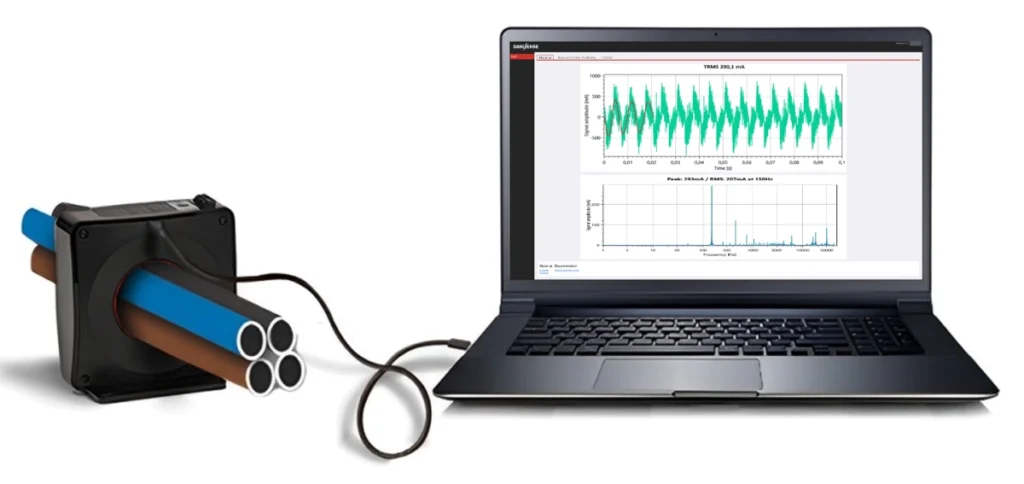
The first machine manufacturers are already integrating these sensors into new systems. The measured values are fed directly into the machine control system, where they can be checked for anomalies in the various machine states. Warning signals can then be forwarded to the future machine operator. This eliminates the need for time-consuming insulation resistance tests during repeat testing by the plant operator. Many operators are enthusiastic about this concept, as it not only increases plant safety but also significantly reduces maintenance costs.
Summary
For small and medium enterprises (SMEs) in industrial manufacturing, the further development of maintenance strategies is an essential factor for competitiveness. Outdated maintenance methods such as reactive maintenance which means that repairs are only carried out when a machine or system is no longer operational. are no longer sufficient for the complexity and interconnectedness of modern production facilities and cause costs to skyrocket.
Notes
1
ISA: How Much Is Plant or Facility Downtime Costing You?
https://blog.isa.org/downtime-factory-plant-industrial-costs-risks
2
LokalPlus: „Jede Stunde Maschinenstillstand kostet ein Unternehmen bares Geld„
https://www.lokalplus.nrw/olpe/jede-stunde-maschinenstillstand-kostet-ein-unternehmen-bares-geld-51439
3
Siemens: SENSEYE PREDICTIVE MAINTENANCE - The True Cost of Downtime 2022
https://assets.new.siemens.com/siemens/assets/api/uuid:3d606495-dbe0-43e4-80b1-d04e27ada920/dics-b10153-00-7600truecostofdowntime2022-144.pdf
4
eMaint: Reducing the costs of downtime in the manufacturing industry
https://www.emaint.com/works/manufacturing_downtime_infographic/
5
BearingPoint: Predictive Maintenance Studie 2021
https://www.bearingpoint.com/de-de/publikationen-and-events/publikationen/chancen-und-herausforderungen-von-predictive-maintenance-in-der-industrie/
6
Boston Consulting Group: Charting AI’s Successful Course in Predictive Maintenance
https://www.bcg.com/publications/2023/predicitive-maintenance-in-manufacturing