
Measuring range extension of DC energy meters
Introduction
The number of direct current applications has risen continuously in recent years. In addition to charging stations for electric cars and photovoltaic systems, high-performance battery systems are increasingly being integrated into supply grids. In many cases, the energy has to be billed on the DC side of the systems. MID-certified DC energy meters are not yet available. There are only national approvals from the mostly national certification laboratories for a small number of products. The responsible organizations have not yet communicated when an internationally valid MID certification for DC energy meters will be made available. So far, there are only national solutions. There is no planning predictability for manufacturers, as is the case with AC energy meters.
The latest DC energy meter technology
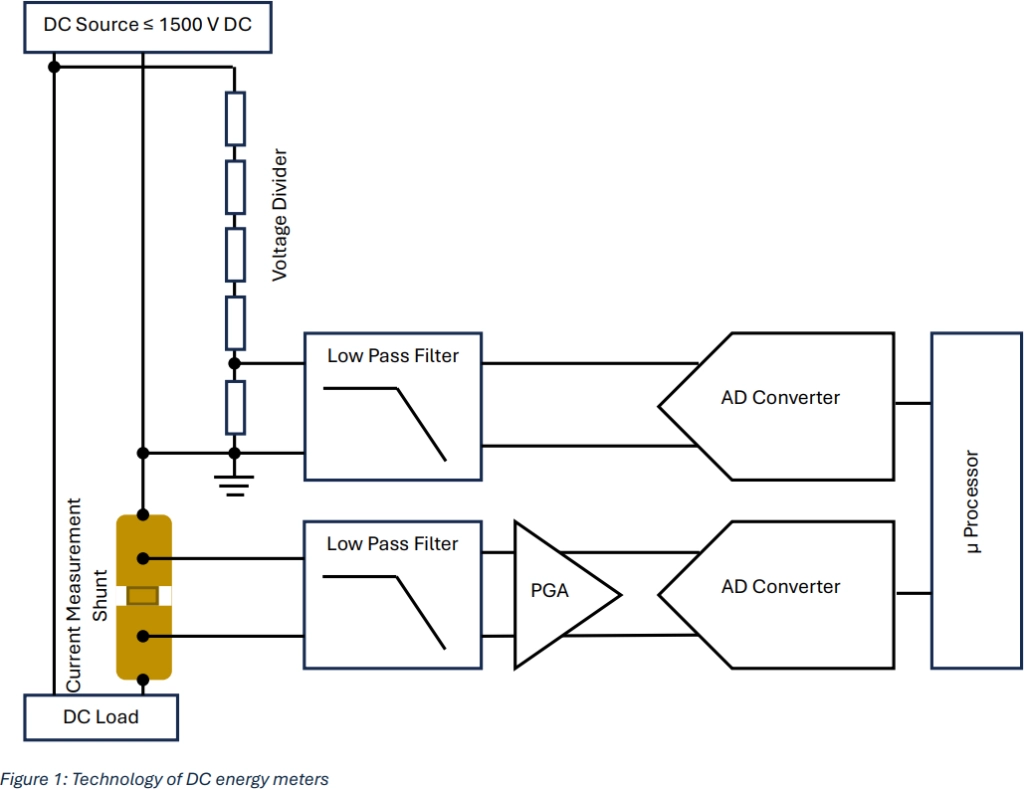
DC meters that have been approved by national supervisory authorities for energy billing in the relevant countries are already commercially available on the market. A national type certification exists. The devices can often handle DC currents of up to 1000 A directly via shunt modules. In most cases, a manganin measuring resistor in the two-digit µΩ range is used. This type of current measurement is cost-effective and is already a wellestablished method. The voltage is measured using a simple voltage divider.
Important standards and parameters
The IEC standard 62053-41:2021 for DC energy meters has been available since June 2021. It applies to two-pole DC circuits up to 1500 V.
The following parameters, which are also defined in the international standard for AC energy meters IEC 62052- 11, are important to understand.
Starting current (IST) means that from this current value, the measured current values must be included in the power calculation. However, currents lower than the starting current may also be included in the power calculation. For the two accuracy classes 0.5 and 1 specified in IEC 62053-41, the starting current is set at 0.4 percent of the nominal current (In).
The accuracy class specified in the data sheet only applies from the minimum current (Imin). The value of 0.5 percent of the nominal current (In) applies to both accuracy classes. No accuracy values are defined in the standard for currents below the minimum current. However, agreements can be made between the manufacturer and the end customer.
A maximum current (Imax) must also be defined. Up to this current, the meter operates with the specified accuracy class and is not damaged even if the maximum current is continuously applied.
The classes for direct measuring DC meters are defined as shown in the following figure. The nominal current (In) is specified at 100 A.
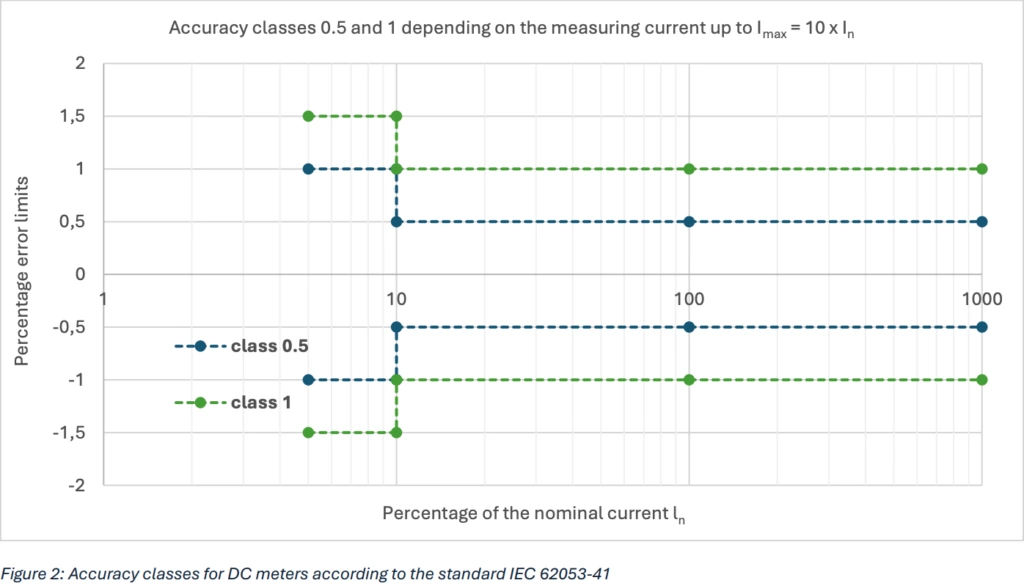
In the example above, a maximum current of Imax = 10 x In is assumed, so that a current of up to 1000 A can be measured continuously. In many direct measuring meters, shunts in the two-digit µΩ range made of manganin are used. The power losses of the measuring shunts remain within an acceptable range up to 1 kA. In addition to the physical and measurement limits, the standard defines a maximum value for the power loss occurring in the current path. The permitted limit value is 120 mW/A x Imax. For the above-mentioned maximum current of 1000 A, this results in a maximum permissible power loss of 120 W at Imax. The power losses up to 4000 A for three realistic resistance values in addition to the defined maximum value are shown in the following diagram.

If DC currents greater than 1 kA must be measured in practice, it is advisable to use DC current sensors with galvanic isolation from the primary circuit. Even if small ohmic resistors with very low resistance values are selected, the measurement signals in the microvolt range are close to the noise floor. It is definitely a technical challenge to perform a measurement without interference, as the measuring point is very close to an MW-range switching converter.
The question of whether international standards must be complied with for these DC current sensors in order to obtain approval from the national supervisory authorities will be analyzed in the following.
Missing standard for DC current transformers for low voltage applications
The latest standard for DC energy meters does not address current sensors for a possible extension of the measuring range. For AC applications, conventional current transformers according to the IEC 61869-2 are used almost without exception, which have to be specially approved for billing purposes. The question arises whether a product standard has also been created for DC current transformers. In a current overview of the IEC 61869 series, we find the product standard 61869-14.

This explicitly deals with current transformers for DC applications. However, the standard only applies to highvoltage applications above 1.5 kV DC system voltage and is primarily intended for the HVDC sector.
The 61869-8, which is currently in progress, could provide a remedy. But here, too, the engineer looking for help will be bitterly disappointed. The scope only covers current sensors in the frequency range 15 to 100 Hz. Furthermore, the standard is only intended to apply to high-voltage applications > 1000 V AC. To understand this approach on the part of standardization, we have to go back to the years 2015 and 2016. During this time, a standardization section exclusively for low-voltage applications was to be developed within the existing IEC 61869 family. The first milestone was to be "IEC 61869-201: General requirements for Instrument Transformers for low voltage applications". The first publication was planned for June 2019. The new publication date listed on the IEC website now is March 31, 2025.1 However, this date also appears to be unrealistic. The coordinator of working group WG49 resigned in 2021. A new coordinator has not yet been found. Activities are currently on hold. For these reasons, it is necessary to make independent considerations regarding the boundary parameters for DC current sensors.
In order to create an overall solution that is acceptable to the national supervisory authorities with regard to the extension of the measuring range for DC energy meters, the following boundary conditions should be implemented.
- The sum of the measurement errors of the current sensor and meter unit should be within the accuracy specification of the direct measuring meter.
- The energy consumption of the sensor should comply with the specification of 120 mW/A x Imax.
- The current sensor should have a low temperature drift and provide stable behavior for at least 10 years.
- The accuracy of the current sensor should be measured in an IEC 17025 certified test laboratory so that the sensor supplier can deliver the current sensor to the meter manufacturer as a tested meter extension
accessory.
It should also be noted that AC energy meters are generally classified in overvoltage category IV. According to the table below, which can be found in IEC 60664-1, an AC meter for a three-phase system with a system voltage of 400 V must withstand a voltage impulse of 6 kV in accordance with overvoltage category IV.

The voltage supply of the DC current transformer should therefore also be designed for overvoltage category IV. The insulation of the transducer head of the current transformer for a DC 300 V system should therefore also be able to withstand a 6 kV surge. In general, overvoltage protection devices that can reliably limit overvoltages are often used in charging stations and other DC systems. By lowering the expected voltage peaks, it is usually possible to simplify the design of the power supply and the plastic housing of the transducer head.
A DC current transformer for DC metering
The Danish company Danisense, known for its zero-flux technology, has been supplying high-precision AC-DC current sensors to many laboratories and areas where high-precision current measurements are required for decades. Due to the accuracy of the sensors in the ppm range (10-6.), an extension of the measuring range for power analyzers is no longer thinkable without zero-flux current transducers. The high-precision current sensors are already being used as reference devices by national supervisory authorities.2
In addition to high-precision laboratory applications, Danisense will also offer current sensors for extending the measuring range of DC energy meters in the future.

The sensors are also based on the zero-flux principle and have a very low temperature drift due to the electrical design of the zero-flux sensor. The IEC 17025-certified test field provides traceable proof of accuracy.
Exceptions in the measuring and calibration directive
The whole procedure can be simplified if higher currents are to be measured and calculated, which are explicitly excluded from the calibration regulation. In Germany, the limit is 5 kA. This is where the consumer protection guaranteed by the calibration ordinance ends. 3 The two contracting parties are categorized as belonging to the professional sector. It can then be assumed that the two parties can independently agree on a reliable billing system.