A ONE STOP SHOP CALIBRATION PARTNER

Danisense Calibration Lab

Calibration service

As part of Danisense’s pursuit of precision and innovation, the Danisense Calibration Laboratory was constructed in 2017. The aim was to improve our technical proficiency and to grow our knowledge of current sensing technology. Since then, we have expanded and improved the calibration service to offer customers highly accurate and reliable calibration of current transducers, with some of the lowest uncertainties available. After learning and building our competence, the first ISO/IEC 17025 accreditation by DANAK was finalised in 2022. The primary objective of Danisense Calibration is always to give the customer useful and trustworthy results.

Calibration Lab

The importance of accurate and reliable current transducers

Laboratory Measuring Capability

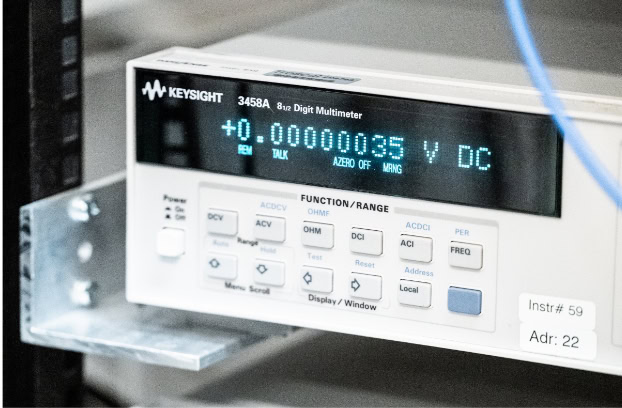
Our state of art laboratory is equipped to handle DC (from 1A to 21kA) and AC 53 Hz (from 1A to 1.2kA) for gain error and phase shift. This extensive range ensures that we can calibrate a wide variety of current transducers with current or voltage outputs.

A One Stop Shop Calibration Partner

Many labs have a mix of current transducers from different brands and technologies, making calibration complex and time-consuming. Our calibration service handles both Danisense and third-party AC and DC current transducers, ensuring accuracy and performance through one trusted partner — saving you time and effort.

Short Lead Time

Our calibration service minimizes downtime with short lead times — typically 10 working days —ensuring your equipment is back in operation quickly. Our efficient team delivers fast, reliable service.

Certified Calibration Report

A Danak-accredited calibration certificate, providing you with the assurance that your Calibration Report meets ISO 17025.

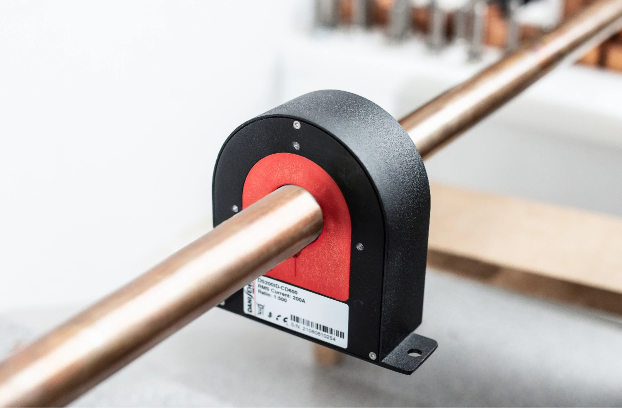
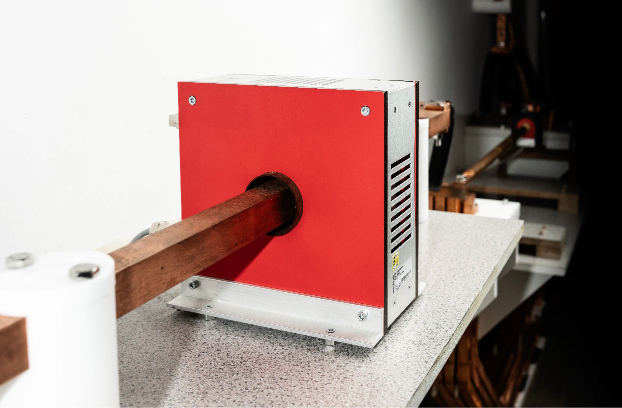
Danisense DS-series current transducer in the calibration lab

Calibration provides knowledge

Calibration is the comparison of measurement values delivered by a device under test with those of a calibration standard of known accuracy. This provides the device user with knowledge of how well the device performs in controlled conditions. Regular calibration of an instrument gives the user confidence in their test results and insight into the reliability of their system.

Calibration provides knowledge We provide AC & DC Accredited Calibration

Accreditation gives international acceptance

Accreditation is the independent conformity assessment by a third party against recognised standards. While each country has its own accreditation body, the EA and ILAC Mutual Recognition Arrangement (MRA) means that once accredited, the accreditation is accepted everywhere. This means that the customer can trust the high standard of the accredited laboratory anywhere in the world. 

Traceability links results to the SI units

Measurement traceability refer to an unbroken chain of comparisons relating an instruments’ measurements to a known standard. Primary standards are used to realise their unit of measure which directly corresponds to their definition in the SI unit system. From this, secondary standards can be calibrated and used in national metrological institutes (NMI) as national standards. By maintaining traceability in calibration, the chain links the users’ instrument directly to the defined physical units. This means that measurement results can be compared using the same units across the world if uncertainty is accounted for.

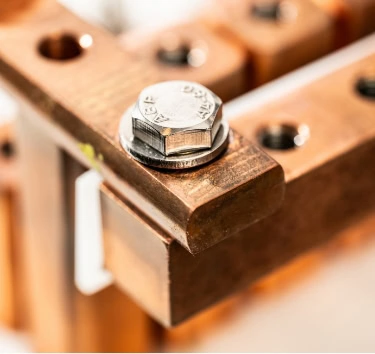
Danisense Calibration Lab copper bus bar setup

ISO/IEC 17025 ensures competence

ISO/IEC 17025 is the internationally recognized standard for calibration laboratories. While similar to ISO 9001, the standard demands high levels of competence in both management and technical aspects of the laboratory to ensure the impartiality and quality of the results.

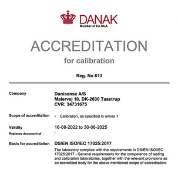
We perform DANAK accredited ISO/IEC 17025 calibration of DCCTs at Danisense Calibration. Our measurement capabilities are found in DANAKs website.

Accreditation

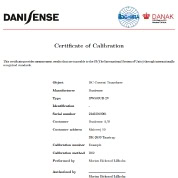
Sample report

AC Accredited Calibration

Standard Calibration Points
Our standard AC calibration report is performed at 10%, 25%, 40%, 55%, 70%, 85% and 100% of nominal AC current. Our DC standard calibration is performed at +/- 10%, +/- 25 %. +/- 40 %, +/- 55 %, +/- 70 %, +/- 85 %, +/- 100 % of nominal DC current. Results are presented with and without offset, with linearity analysis and statement of conformity (for Danisense transducers only) on all test points. Custom Calibration Points In case of our standard calibration points do not match the requirement, we are offering the possibility to customize these points.

DC Accredited Calibration

Standard Calibration Points
Our standard DC calibration is performed at 0, ±10%, ±25%, ±40%, ±55%, ±70%, ±85%, ±100% of the transducer nominal DC current. Results are presented with and without offset, with linearity analysis and statement of conformity (for Danisense transducers only) on all test points. See sample report for details.

An example of the uncertainties we provide at different current levels in DC calibration:

Measuring Capability

DC1A - 21kA
AC ratio (53 Hz)1A - 1.2 kA
AC phase (53 Hz)1A - 1.2 kA
Current output DCCTVoltage output DCCT
100 A6 ppm17 ppm
1000 A
6 ppm17 ppm
10000 A21 ppm26 ppm

Please note that the actual uncertainty of calibration results depends on the device under test and the measurement conditions. 

Danisense calibration lab current transducer

Questions? We are
here to help you

Any questions regarding DC calibration or AC calibration contact us at calibration@danisense.com or book a calibration

When ordering a calibration please fill out our CRMA Form